First, the spoiler. The five questions are:
Phase 1: Be subjective
- If not the thing you’re currently making, what thing would you rather be making?
Phase 2: Be objective
Does the problem you want to build the thing to solve exist?
Do people trust the thing you’re making to solve it?
How much value do they place in its being solved by the thing you’re making?
Phase 3: Be subjective
- Do you want to be the one to do it?
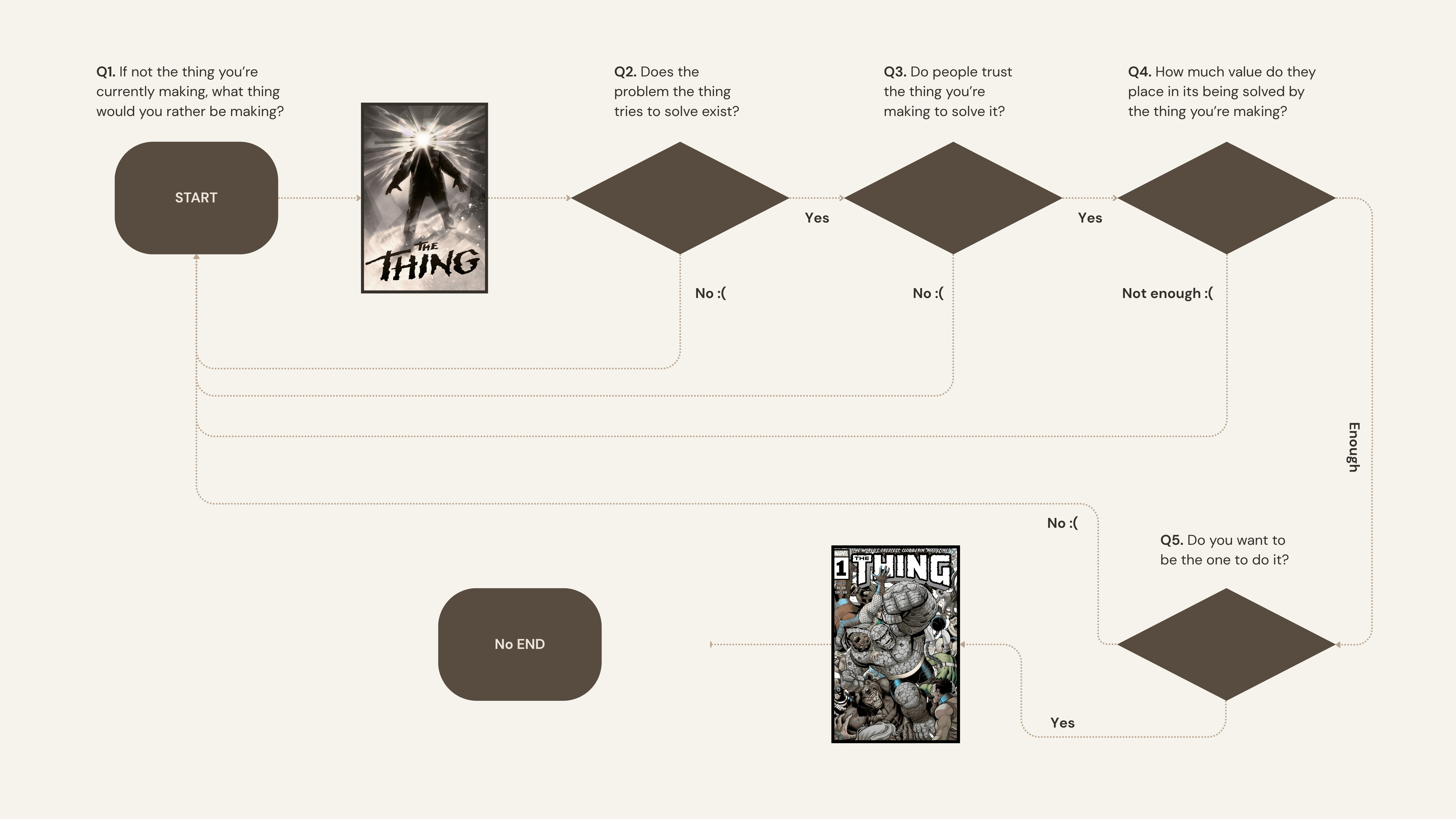
Question 1: If not the thing you’re currently making, what thing would you rather make?
Alternatively: if not the problem you’re currently solving, what problem would you rather solve?
At its core, I think of every endeavour – be it personal, professional or creative – as being born out of a need or desire: either stated or unstated. Endeavour is another word, in a sense, for the ‘invention’ whose mother is ‘necessity’. Seen through this lens, we’re all makers of things.
We’re makers of things rather than senders of emails. Makers of things rather than owners of products. Makers of things rather than session drummers.1
Entrepreneurship as megalomania
I’m going to recognise entrepreneurial endeavours as what they are in their entirety.
No doubt they’re tough, more likely to fail than succeed, yada yada (there’s no shortage of that sort of literature, so I won’t get into it).
They might also on several levels be brave and liberating (even more literature of this variety, so I won’t get into this either).
On the most fundamental level, however, they’re driven by megalomania. Within the context of the subject-object dialectic I often like to discuss (long-time readers celebrate mention of the subject-object dialectic; for new ones, a footnote2), deciding to start a business is an expression of one’s subjective nature. That is to say, when faced with the question – professionally, if not the problem you’re currently solving, what problem do you want to be solving? – if one believes that the best way to answer the question is as a proprietor, that’s an exercise of one’s agency.
There’s nothing wrong with the occasional bout of megalomania, if you’re so inclined, if you have a firm hypothesis of what you’d be making instead. For those of us so inclined, the occasional megalomania is proof that we don’t buy the narratives for the future others sell us. That we too have an agenda for our lives. We too have an opinion on how it must be led. And we have the gumption to deliver against this vision.
That’s what I experienced when decided to start Milk Toast as a way to help small businesses solve complex revenue challenges. Does the new thing you make have to be ‘a business’?
Questions 2-4: stress-testing your solution
Let’s say you decide to switch from making the thing you were making (in my case, growth strategies at my stable, well-paying job) to the thing you want to be making instead (in my case, revenue solutions at Milk Toast). If the thing you’re making is goods and/or services, and if what you receive in exchange for those goods and/or services is money, congratulations. You’re ‘starting a business’.
You join the ranks of your favourite hole-in-the-wall sandwich shop. The hardcore band you loved growing up that insisted on rising above. The email client or app on which you found the link that got you here. Here.
If deciding to make a thing is an exercise in agency, getting others to part with their time and money to use that thing is an exercise in humility.
Right from the day you puff your chest and decide to start a business, you’ll find yourself asking three questions. Every day.
Does the problem you want to build the thing to solve exist?
Do people trust the thing you’re making to solve it?
How much value do they place in its being solved by the thing you’re making?
That is to say, you will no longer be a subject with agency.
With Milk Toast, I knew from the outset that the answer to question one was yes. Would certain businesses benefit from an external set of eyes on growth challenges? Of course. Whole industries with varying degrees of repute exist to solve that very problem for businesses of every scale. Angel funds, VCs, PEs, agencies, consultants, banks, venture debt funds, startup podcasts aimed at those who fantasise about starting up but don’t, advisors, sales guns for hire, sales forces for hire, sales agents, AI sales agents, AI sales agents that plug into your CRM solution, AI sales agents that plug into your AI-native CRM solution, AI sales agents that plug AI into your AI-native CRM solution. You get the drift: it’s safe to say that every business spends a significant portion of its resources trying to solve the problem of growth.
This essay’s first random walk
Contemporary society’s drive for constant growth has not been the norm for human civilisation. For far longer, human civilisation has been driven forward by other impetuses.
The drive to survive. The billions among us who are not as fortunate as those reading this likely continue to be driven by this core drive. Per Netflix, so is Daniel Ricciardo.
The drive for salvation. The pious among us are likely animated by this impulse above others.
At other times, parts of human civilisation have been driven by the drive to explore, the drive for power, the drive for _______ and other such impulses.
Some argue that the age of capital and industrial mass-production set the wheels of necessary growth in motion. I remember watching the lectures of David Harvey – a socialist – as an undergraduate (when else?). In them, I recall he argued that, in the long run, modern capitalism was incompatible with his view of the real world. Modern capitalism demands, he suggested, a 3% annual global GDP growth rate forever, but the world is finite. Its resources are finite. The value that can be given to its finite population is finite. How could the world possibly sustain a compounded annual growth rate of 3%?
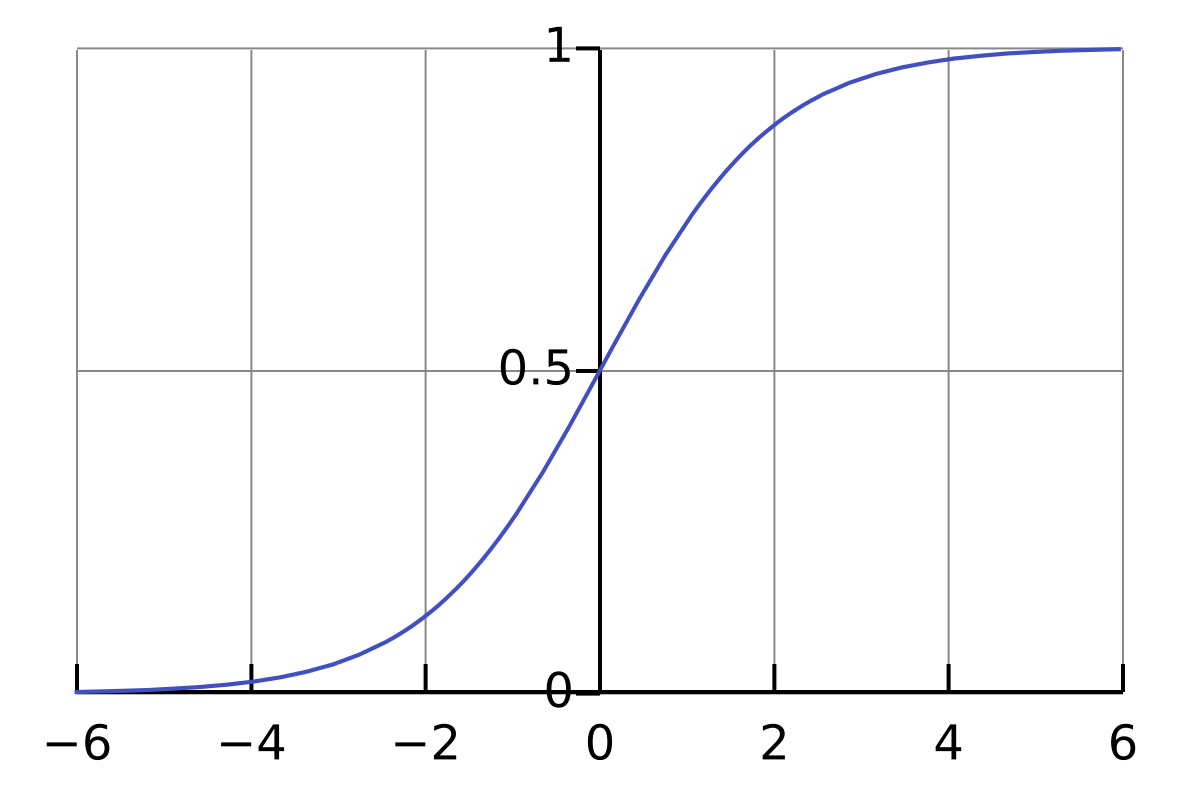
Uber-capitalist accelerationists like Elon Musk have since echoed similar views as folks like David Harvey, their ideological opposites. They argue, among other things, that the only way human civilization thrives long-term is as a multi-planet species. Vaclav Smil bisects these arguments with the view that ‘no trees grow to heaven’, arguing that all growth – be it in organisms or human-made – follows a sigmoid curve.
- Others take a more essentialist view and speak of moral decay – greed, gluttony, Sodom and Gomorrah. The post-War west, these ideologues argue, has since the 1950s championed a culture of overconsumption. Society’s obsession with growth is the core tenet of Americanism as a philosophy: the primary export of the twentieth century’s prime hegemon. Mad Men, A Few Good Men, Tom Cruise, the TV dinner. Some among them argue for a more atavistic lifestyle. Others argue for a collective utopia free of greed.
Others still argue that the drive for growth isn’t new. The industrial revolution did not invent growth; it accelerated it. Through a Eurocentric lens, this is true. But seen through an Asiacentric lens, the industrial revolution in fact slowed down centuries of growth within the geographical boundaries of modern-day China and India, which contained, before it, the largest economies in the world. De-averaging global numbers, therefore, tells a more complicated story.
More ideas on growth pessimism here. I, of course, am not a growth pessimist, but it’s important to note that there’s a rich tradition of that variety of thought.
Back to the topic at hand – the three questions
Does the problem you want to build the thing to solve exist? Yes.
Do people trust the thing you’re making to solve it?
How much value do they place in its being solved by the thing you’re making?
On to the second question. *Do people trust the thing you’re making to solve it? *The best way to answer this is feedback from others (users, paying clients, customers, your choice of words).
When I started Milk Toast to be an embedded revenue services firm nearly four months ago, I only knew that small-to-large-sized consumer tech & SaaS organisations were happy to employ me as an individual to solve challenges of scaling revenue. Except for the first year-and-a-half of my career, in which I worked as a sustainability consultant, and a year in the middle, in which I was as a full-time novelist, that’s what small-to-large-sized consumer tech & SaaS organisations have paid me to do. As an individual. Do people trust the thing I’m building – Milk Toast – to solve it?
There’s a simple – but not easy – way to answer this question. It’s contained in what is perhaps *the *Paul Graham essay – Do Things that Don’t Scale. I particularly like this quote. Like the essay that contains it, the quote is written with product startups (primarily in the SaaS space) as its intended audience: it’s what you expect from a YC co-founder. But the ethos applies to services businesses like Milk Toast as well.
Even if you start the way most successful startups have, by building something you yourself need, the first thing you build is never quite right. And except in domains with big penalties for making mistakes, it's often better not to aim for perfection initially. In software, especially, it usually works best to get something in front of users as soon as it has a quantum of utility, and then see what they do with it. Perfectionism is often an excuse for procrastination, and in any case your initial model of users is always inaccurate, even if you're one of them. That is to say: feedback is the best way to answer this question. Feedback almost always results in a change in direction in the beginning of any endeavour, and that’s as intended. Flickr and Slack both started their lives within gaming companies led by Stewart Butterfield. And Instagram was a Foursquare-like app before it became the reason most of our brains can’t hold a coherent thought in our minds for longer than 2 seconds. User feedback played a significant role in the evolution of each of those companies. Stubbornness on the part of those founding teams would’ve resulted in two failed games and a more well-adjusted society.
It’s only once one finds the answer to the question – do people trust the thing you’re making to solve it? – to be ‘yes’ that one should move to the third question.
1Each of the above is a specific example of what people I know identify as.
2A subject is a being that exhibits agency. An object is that which is observed. There are many debates about subjectivity & objectivity in philosophy. In the context of this essay (and earlier ones), I ask the most prosaic of these questions. Are we able to exert agency on our surroundings and change them? Or are we mere objects in relation to a subject that’s much much larger than us?
2 Likes∙2 Restacks22
This site requires JavaScript to run correctly. Please [turn on JavaScript](https://enable-javascript.com/) or unblock scripts